Angular Bathroom Mirror with LED Outline: Where Would That Actually Work?
In the ever-evolving world of modern bathroom ideas, the angular bathroom mirror with an LED outline has rapidly become a design favorite. Its sleek aesthetic, clean lines, and functional lighting offer both style and utility, making it a compelling alternative to traditional vanity light bars and sconces.
But just because something looks stunning in a product warm vs cool led mirror lighting catalog or on Instagram doesn’t always mean it lives up to the promise in real life. After editing bathroom content for over a decade and reviewing many real layouts, I’ll walk you through where an angular LED-outlined mirror truly shines, the subtle lighting nuances that impact your walls, and how to avoid common pitfalls. We’ll also reference trusted industry voices like Homedit and LED Mirror World for additional insight.
Why Replace Vanity Light Bars and Sconces with LED Mirrors?
The bathroom lighting game is changing. For decades, the standard lighting for a bathroom vanity was a combination of light bars above the mirror or wall sconces flanking it. While these are classic, functional choices, they impose one lighting pattern and can create unwanted shadows, especially on faces.
LED mirrors with illuminated outlines—often angular or geometric in shape—offer a unified solution:
- Integrated light source: The illumination is right where you need it, surrounding the mirror surface and casting consistent, even light on your face.
- Decluttered space: No need for bulky or multiple fixtures on the wall—just one elegant mirror assembly.
- Energy efficiency and dimmability: Most LED mirrors feature modern LED strips that consume less power and often offer adjustable brightness or color temperature.
Many designers see these as a modern evolution, but LED lighting isn’t one-size-fits-all. There are distinct lighting methods to consider.
Backlighting vs Edge-Lighting vs In-Glass Light Lines
When discussing LED outlines on mirrors, it’s critical to clarify how the lighting integrates with the glass surface. There are three primary methods you’ll see in the market and online sources like LED Mirror World:
Backlighting
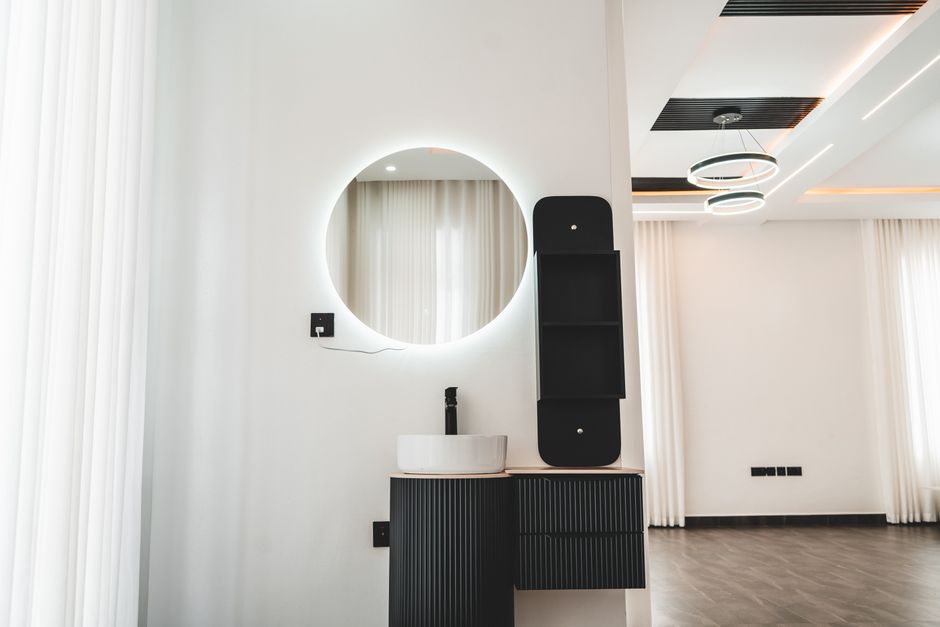
Backlit mirrors have LED strips mounted behind the entire mirror panel. The light washes outward from the perimeter of the mirror onto the wall behind, creating a glowing halo effect.

- Wall impact: Backlighting casts ambient light gently on the painted wall, tile, wood, or stone, producing a subtle glow that enhances texture and color of the wall surface. It’s especially impactful on matte or rough textures.
- Use case: Works well when your wall finish deserves subtle emphasis or when you want an atmospheric, indirect lighting mood. It’s less harsh on the eyes.
- Note: Backlighting requires some wall clearance behind the mirror for mounting, which may limit use in tight quarters.
Edge Lighting (LED Outline)
This is the classic illuminated outline you visualize with an “angular bathroom mirror with LED outline.” In this setup, the LED strip is attached along the mirror’s edge, often cut or framed to sharp angles. The LED light is channeled through the glass, illuminating the edges of the mirror itself.
- Wall impact: Edge lighting creates a brilliant, crisp glow outlining the mirror’s shape, often casting faint linear refractions onto the adjacent wall. Because the LED source is very close to the wall surface, the light wash effect can look sharp on smooth, glossy tiles but might be more subtle on matte paint or stone.
- Use case: Ideal for rectangular or angular mirrors where the mirror’s shape itself is the design star. Edge-lit mirrors do double duty as art objects and lighting sources.
- Watch for: In real life, strong edge lighting can sometimes feel sharper or colder than photos imply, especially with overly blue “luxury” LEDs. Warmer color temperatures often feel softer and more flattering.
In-Glass Light Lines
I'll be honest with you: this is a newer, more intricate lighting method where led strips are embedded inside the the mirror glass along specific lines or shapes, creating glowing graphic or colored patterns.[1]
- Wall impact: The focused illuminated lines produce precise light accents on the mirror surface itself, translating to minimal light wash on surrounding walls.
- Use case: Excellent where the mirror is as much decorative sculpture as functional object—think artistic bathrooms or boutique hotels.
- Caution: If your mirror includes busy stone veining or patterned tile backsplash, these glowing lines might create visual clutter and fight for attention.
Angular Bathroom Mirror and Wall Surface Interplay
Choosing the right mirror lighting technique is inseparable from your wall materials. An angular LED mirror can dramatically change the perception of your bathroom’s textures and colors.
Wall Surface Effect of LED Edge Lighting Effect of Backlighting Design Considerations Matte Paint Light washes softly, brings out subtle color shifts and texture; sometimes edges appear more defined. Creates gentle halo effect on wall, ideal for relaxing ambiance. Choose warm LED tones—blue hues tend to clash and feel clinical. Glossy Ceramic Tile Sharp reflections and distinct edge light refractions contribute to a high-contrast, striking look. Backlighting can be lost on highly reflective surfaces unless offset with contrasting grout colors. Edge lighting works best if tile color complements LED warmth. Wood Panels or Veneers Edge lights emphasize mirror lines but light reflections on wood can feel uneven. Backlighting creates a warm glow that enhances wood’s natural grain and richness. Never use overly cool LEDs; emphasize ambers and soft whites. Natural Stone (Marble, Granite) Edge lighting highlights angular mirror sharply, but lighting can clash with stone veining complexity. Backlighting washes gently over textured surfaces, highlighting depth and veining. Use simple mirror shapes so that lighting complements rather than competes with stone patterns.Long Bathroom Vanities and Multiple Angular LED Mirrors
For longer vanity countertops—think double or triple sinks—the angular LED bathroom mirror opens unique layout possibilities. Instead of a lengthy single mirror, multiple angular mirrors can be arranged in a linear or staggered fashion, each outlined with LED light, creating rhythm and visual interest.
- Benefits: Defines individual sink zones, especially valuable for family or shared bathrooms.
- Lighting consistency: Multiple LED mirrors can be synced for uniform brightness and color temperature, eliminating dips or hot spots across the vanity.
- Wall coverage: Modular mirrors allow you to emphasize special wall finishes—like tiling or wood paneling—between or around the mirrors, avoiding large uninterrupted reflective surfaces.
Industry leader LED Mirror World often showcases these multi-mirror configurations in their sample layouts, while online forums and design groups on Twitter and Facebook provide peer feedback on real-world installations.
Colored LED Mirrors: A Stylish Twist or Gimmick?
One trending modern bathroom idea is the colored LED mirror, where the LED outline shifts through hues or can be chosen in a fixed non-white tone—like cool blue, warm amber, or even playful pink.
While vibrant lighting can energize a space or enhance mood, caution is warranted:
- Wall color influence: Colored LED light strongly changes perceived wall paint colors and tile tones, which can clash or overwhelm subtle countertop or cabinetry finishes.
- Use sparingly: Reserve colored LEDs for guest powder rooms or vignettes, where bold style choices don’t affect daily routines.
- Functionality: Colored lighting isn’t ideal for makeup application or shaving tasks that require true color rendering.
Cross-check usage insights on social platforms like Twitter, where homeowners often share before-and-after photos and review real-life usability of colored LED mirrors.
Final Thoughts: Where Does an Angular LED Bathroom Mirror Really Work?
To summarize, an angular bathroom mirror with LED outline works best in these scenarios:
- Bathrooms with supporting wall surfaces: Matte paint, textured stone, or wood walls that interact thoughtfully with LED lighting.
- Medium to large vanities: Especially for segmented mirror layouts that benefit from clean, angular outlines and consistent illumination.
- Minimalist to modern design schemes: Angular LED mirrors complement simple rectangular shapes where the lighting does the heavy lifting without visual competition.
- Environments prioritizing sleek functionality: Where removing traditional vanity bars and sconces declutters the room.
Conversely, avoid angular LED outlined mirrors in small, cramped bathrooms with highly patterned stone or tile backdrops where the lighting effect may feel harsh or chaotic. Also, be wary of overly blue lighting touted as “luxury”—this can feel clinical rather than inviting.
For further inspiration and trusted product reviews, turn to sites like Homedit or Google’s trusted directory of Verified Sources specializing in bathroom lighting. Follow discussions on Twitter and Facebook to see authentic user experiences in diverse bathroom settings.
References
- LED Mirror World – Comprehensive portfolio of LED mirror types and lighting effects.
- Homedit – Expert insights on modern bathroom lighting and mirror trends.
- Social media feedback on Twitter and Facebook.